Large High Altitude Air Shower Observatory (LHAASO)
Official website: http://english.ihep.cas.cn/lhaaso/.
The Large High Altitude Air Shower Observatory (LHAASO) mainly aims at exploring the origin of high-energy cosmic rays and conducting scientific researches on high energy astrophysical radiation.
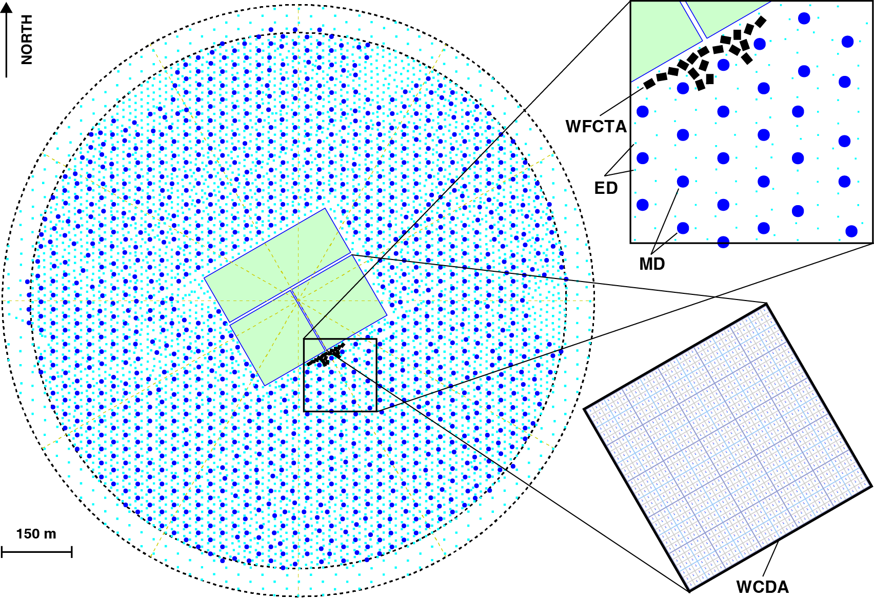
LHAASO is located 4410 meters above sea level (a.s.l.) on Mt. Haizi in Daocheng County, Sichuan Province, China, and covers an area of 1.36 km^2. The construction of LHAASO project is under the charge of the Chinese Academy of Sciences (CAS), executed by Institute of High Energy Physics and the Chengdu Branch of CAS. The construction of LHAASO lasted for 4 years and was completed in July 2021, then the full array was put into operation. The project passed the national acceptance on May 10, 2023. LHAASO is currently operated and maintained by the Institute of High Energy Physics, CAS.
LHAASO uses four different types of detectors working in concert to get a complete picture of an air shower:
KM2A (Km^2 Array):Consisting of 5215 Electromagnetic particle Detectors (embedded in the ground to detect showers of electrons and photons) and 1188 Muon Detectors (located underground to filter out muons, which are a key signature for cosmic rays).
WCDA (Water Cherenkov Detector Array):Three immense ponds (totaling 78000 square meters) filled with ultra-pure water. When particles travel faster than light speed in water, they produce Cherenkov light, which is detected by sensitive photomultiplier tubes.
WFCTA (Wide Field-of-View Cherenkov Telescope Array):18 telescopes that observe the faint ultraviolet Cherenkov light emitted by air showers in the atmosphere.
This multi-technique approach allows LHAASO to reconstruct the type, energy and direction of incoming cosmic particles with unprecedented accuracy.
What are cosmic rays?
Cosmic rays are high-energy particles coming from outer space and are mainly composed of protons and the atomic nuclei of many elements, as well as a small fraction of electrons and Gamma ray photons. Constantly present on our planet, cosmic rays were first discovered by Austrian scientist Victor Hess in 1912.
Cosmic rays span an energy range of 10^9 -10^20 eV. As the energy of cosmic rays increases, their abundance decreases, so larger area instrument for their detection are required.
The origin of cosmic rays - A mystery of the century
The majority of cosmic rays are charged particles, which are deflected in the interstellar magnetic field during their propagation. When they arrive at the earth, the original directional information is lost. We are yet to solve the origins of high-energy cosmic rays, thus to find out the mechanism of their production and acceleration.
Cosmic rays carry important information of the nature, including the evolution of the universe, celestial dynamics, solar activity and geospatial environment. The origin of cosmic rays has been listed as one of the top scientific questions in astrophysics.
File Download: